Mostrando entradas con la etiqueta Colonies. Mostrar todas las entradas

jueves, 29 de marzo de 2012

KENYA


KENYA

Kenya, officially the Republic of Kenya, is located east of Africa, bordered by Ethiopia to the north, Somalia to the east, Tanzania to the south, Uganda to the west and South Sudan to the northwest.
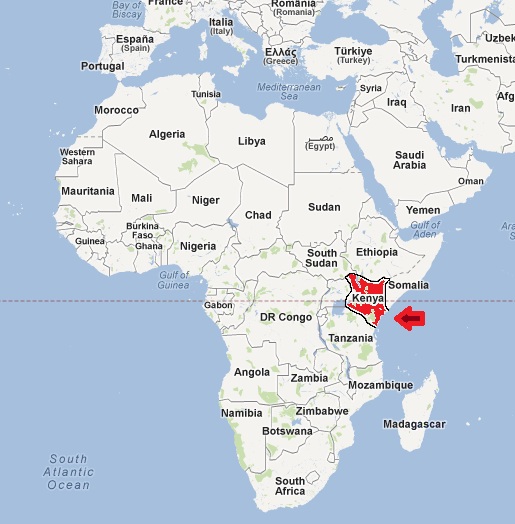
Its capital is Nairobi and its land area is 580,000square km. Kenya has 47 districts, each with a semi-autonomous government of the central government in Nairobi. 
Its population consists of 39 million people with many cultures and backgrounds.
In Kenya is Mount Kenya, which gives its name to the country, and is the second highest mountain in Africa.
Mount Kenya

Kenya has highly variable demographics: there are areas of savannas, arid and semi-arid, and a large Indian Ocean coastline. The central and western regions are forests and mountains while the northern regions are more arid.

Kenya's economy is also the largest GDP of the eastern and central Africa. The country has been a traditional producer of tea and coffee, and more recently has focused on the export of cut flowers to Europe. Kenya is also a world power in sports.
Tea plantation
HISTORY
The colonial history of Kenya begins with the establishment of a  German protectorate over the coastal possessions of the Sultan of Zanzibar in 1885, followed by the arrival of the British East African Company in 1888. Incipient imperial rivalry ended when Germany gave its coastal holdings to Britain in 1890.

It was the Kenya African National Union of Jomo Kenyatta the political force that formed the first government after independence in Kenya on 12 December 1963. Kenyatta became the leader of the country at first as Prime Minister and, from 1964, when Kenya became a republic, the first President of the Republic.
Jomo Kenyatta

Despite the fears of the settlers, the Kenyatta government was moderate, pro-Western and progressive. Although Kenya in the late 1960's was, in fact, a one-party state were allowed considerable freedom within the party and the government rarely abused in their performances. The moderate and stable political government of Kenyatta attracted a large number of foreign investors, established a new industrial area near Thika, and modernized central Nairobi. The tourism industry, based on the great national wildlife reserves, expanded rapidly to become the largest source of foreign exchange. Kenyatta was recognized at the time of his death in 1978 as Mzee (old witch), not only for its own people but by a wide range of world leaders.


viernes, 23 de marzo de 2012

Nigeria

Hello everyone!

Nigeria, which is officially the Federal Rebublic of Nigeria, is a federal constitutional republic comprising 36 states and its Federal Capital Territory, Abuja. Its coast in the south lies on the Gulf of Guinea on the Atlantic Ocean. Nigeria is located in West Africa and shares lan borders with Niger, in the north, the Republic of Benin, in the west, and Cameroon and Chad, in the east.

Moreover, there are three ethnic groups, which are the most influencial and largest: the Hausa, in the north; Igbo, chiefly in the southeast; and Yoruba, which is found predominantly in Nigeria and make up around 21% of its population.
Actually, the first European "explorers" were Spanish and Portuguese. They began trading with ethnicities of the coast and negotiating a trade slaves. Subsequently, Britain abolished the slave trade in 1807 and, after the Napoleonic Wars, established the West Africa Squadron in order to stop the international traffic of African slaves. Many years later, exactly in 1885, British demand to a West African sphere of ingluence acquired international recognition and ,one year later, the Royal Niger Company chartered under the leadership of Sir George Taubman Goldie. Afterwards, the company's territory became under the controle of the British Goverment in 1900. Finally, in 1901, Nigeria came to be a British protectorate and part of the British Empire.

On the other hand, the Niger area formally became part of the Colony and Protectorate of Nigeria, and Nigeria went on being divided into the northern, where slavery was not abolished until 1936, and southern provinces and Lagos Colony. 

Thereafter the World War II, due to the growth of Nigerian nationalism and demands for independence, consecutive constitutions, which was legislated by Britain, moved Nigeria towar self-government on a representative federal basis. As a result of the grate wave for independence of Africa, Nigeria got its independece from the United Kingdom in 1960 and created a government consolidated by convervative parties: the Nigerian People's Congress (NPC), the National Council of Nigeria and the Cameroons (NCNC).


Flag of Nigeria


martes, 20 de marzo de 2012

South Africa

Hi everyone! I chose South Africa because is inquestionable its importance in the british colonization of Africa. During more than 100 years (1806-1910) the also known as "Cape Colony" was dominated by the British, however, also Dutch were interested in  domaining its territories, so the two powers were invloved in the historical Anglo-Boer War (1899-1902). British Empire won that war and kept its rule on the colony.
It's remarkable its great location in the southern coast of the continent and, overall, this region was (and currently is) wealthy in different and very apreciate minerals as gold and diamonds. About diamonds exploitation, you can see the 2006 film "Boody Diamond", which relate those practise nowadays, since this problem was not ended with the end of colonization, but after that the local tyrants keep people as slaves in the searching of the wanted mineral.
Finally, I want colclude this entry with a brief comment: after the rule of British Empire black people's suffers did't finish, since Apartheid was instaured durind about 50 years (1940-1991), and race segregation was a unhappy reality in South Africa. But we maybe will speak about that in followings posts.


Goodbye!!

martes, 13 de marzo de 2012

More on Egypt


EGYPT, Under British rule from 1882 to 1952


This pictures shows the traditional sea route to India, sailing around Africa, and the short-cut to India through the Suez Canal.

Britain's interest in Egypt is quite obvious!


viernes, 9 de marzo de 2012

Egypt. The path between Britain and India

British military and politicalinteresting in Egypt became obvious in the 18th century. India was fallingunder the influence of Britain (and away from France). Despite, the direct sailroutes around the Cape of Good Hope, Egypt still provided the quickest way ofmaintaining communications between Britain and India. It required a briefoverland journey, but it was still substantially quicker than circumnavigatingAfrica.


It was thestrategic foresight of Napoleon that first pointed out the importance of Egyptto Britain. In 1798, he had the audacity of landing an army in Egypt thatpromptly defeated the Mameluke Army at the Battleof the Pyramids. All of a sudden,British alarm bells began ringing as they realised that their profitable IndianEmpire was under direct threat. The Royal Navy was able tosave the day and the French Fleet was destroyed at the Battle of Aboukir Bay. Stranded, there was little that the French armycould do and Napoleon promptly abandoned them to their fate. The Frenchsurrendered in 1801.


It seemed as if the Britishforces would remain in place and Egypt would just have remained under Britishcontrol. Unfortunately for the British, in 1805 a vigorous Egyptian leader cameto the fore, known as Muhammed Ali. He took control of the Mamelukearmy and defeated the British in 1807. This setback forced them towithdraw from Egypt.